
Wavetable synthesis
Kurze Antwort
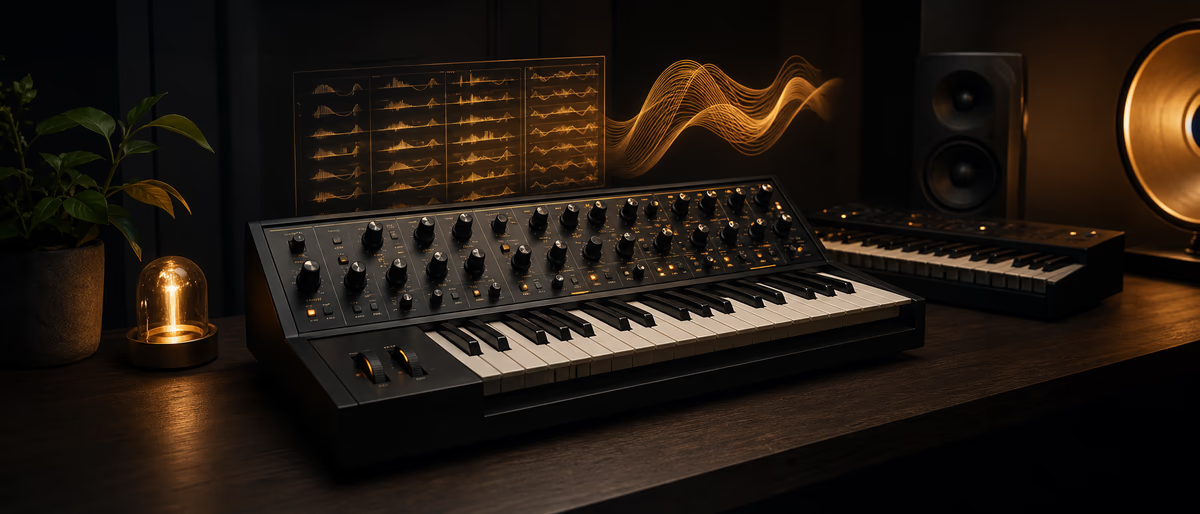
Wavetable synthesis stores many single-cycle waveforms as frames in a table, then plays (and can morph between) those frames while pitch stays under keyboard control. Unlike a fixed saw or square oscillator, moving wavetable position changes harmonic content at the source—before filters and effects finish the sound.
What Is Wavetable Synthesis?
Wavetable synthesis is a digital sound-design method that builds tones from stored waveforms—usually short, single-cycle shapes digitized as amplitude values and collected into a table. Playback loops a chosen section of that table so you hear a continuous note; changing where you read in the table (and optionally interpolating between adjacent shapes) changes the timbre without necessarily changing pitch.[1]
In modern plugins, each stored single-cycle shape is usually called a frame (or index). A wavetable is the ordered stack of those frames. When position sits still, the oscillator behaves like a fancy fixed waveform. When position moves under an LFO, envelope, or manual automation, the harmonic content of the oscillator itself evolves—pads bloom, basses grind, leads “scan” through metal and glass textures.
That evolving-option is the practical difference from static sample playback: a long PCM sample can be rich, but classic wavetable workflow is built around morphing through related single-cycle spectra while filters, distortion, and modulation do the rest.[2] For a hands-on programming walkthrough after this definition article, see our wavetable synthesis tutorial.
- Frame One single-cycle waveform stored in the table (for example a soft sine-ish shape, a bright saw-like shape, or a noisy digital partial stack).
- Wavetable / table The ordered set of frames you can scan. Position picks which frame (or blend of neighboring frames) is heard.
- Table lookup The engine reads amplitude values from memory at a rate set by pitch—same core idea as a table-lookup oscillator, with multi-frame morphing on top.[1]
- Position / WT Pos The control that selects the current frame. Modulating it is the signature wavetable move.
Wavetable vs Subtractive Synthesis
Classic subtractive synthesis starts with a harmonically rich, usually fixed oscillator shape (saw, square, pulse, noise) and sculpts it with filters, envelopes, and amplifiers. The oscillator’s spectrum is largely “chosen once”; most motion comes from filter cutoff, resonance, and amp envelope.
Wavetable engines still use filters—many legendary instruments even paired digital tables with analog-style filters—but they add a second axis of motion: source spectrum changes when position moves. You can leave position static and treat a bright frame like a saw in a subtractive patch, or you can scan frames so brightness and formant character change even with the filter wide open.[2]
In practice the best modern patches are hybrids: wavetable motion for character, subtractive filtering for body and mix fit, plus FX for space. Compare that stack with related methods in our synthesis types guide and FM synthesis beginner guide.
| Aspect | Subtractive (classic VA) | Wavetable |
|---|---|---|
| Oscillator source | Few fixed shapes (saw, square, triangle, noise) | Many single-cycle frames in a table |
| Main spectral motion | Filter cutoff, resonance, drive | Frame position + filter (and often warps/FM) |
| Typical sweet spot | Basses, pads, leads with analog-style motion | Evolving pads, digital basses, modern EDM leads, FX |
| Beginner entry | Pick a saw, close the filter, open with envelope | Pick a table, find a good frame, then automate position slowly |
| Risk if overused | Static or overly filtered tone | Harsh digital edges, aliasing, or restless scanning |
Frames, Tables, and How Position Works
Think of a wavetable as a flip-book of single-cycle drawings. Frame 1 might be nearly sinusoidal; later frames might pile on odd harmonics, pulse-width-like duty cycles, or inharmonic digital grit. The synth loops the current frame at the note’s frequency so pitch is musical, while the drawing you loop can change over time.[1]
Smooth engines interpolate between neighboring frames so position does not hard-step through the book. Without interpolation, crossing frame boundaries can click or create abrupt spectral jumps; with it, morphs feel continuous—closer to what producers expect from Serum-class tools.[1]
You do not need to understand spectral analysis to use this. Audition frames with position static until you hear a shape you like, then decide whether the patch needs motion across nearby frames or a locked “best frame” treated like a VA oscillator. Ableton’s sound team describes modulating table position as similar to “playing a sample,” except you control speed and start region without necessarily changing pitch.[2]
What a frame is not
A wavetable frame is not a full drum loop or vocal take. Long multisamples and granular engines are different tools—even when they live inside the same plugin as a wavetable oscillator. Confusing PCM “wavetable” marketing on 1990s PC sound cards with multi-frame morphing is a common terminology trap; genuine musical wavetable workflow is about scanning related single-cycle spectra, not streaming full songs from ROM.[1]
Position Modulation: Where the Magic Happens
If you only remember one design habit: modulate wavetable position on purpose. Slow triangle or sine LFOs create living pads. Envelope-driven position can make a pluck start bright and settle dark. Velocity can pick brighter frames on hard hits. Random or sample-and-hold modulation yields glitchy digital movement useful in techno and experimental work.
Classic hardware already treated scanning under envelopes and LFOs as core technique; modern soft synths expose the same idea with visual tables and deep modulation matrices.[1][2] Pair position motion with a low-pass filter envelope so high partials do not sit raw in the mix the whole note.
- Slow LFO on position Evolving pads and atmospheres; keep depth modest so the table does not thrash every bar.
- Amp or filter envelope → position Attack-bright plucks and basses that settle into a darker sustain frame.
- Velocity → position Performance dynamics: harder keys pick denser frames without raising volume alone.
- Manual automation Build-ups and drops: ride position like a filter sweep for arrangement drama.
- Unison + slight position offsets Wide modern leads; detune carefully and high-pass the stack if mud builds.
After position motion is musical, add the subtractive half of the patch: filter cutoff, resonance, drive, and a clean amp envelope. That order—choose table, choose home frame, add motion, then filter—keeps beginners from drowning in warps and FX first.
A Short History (Without the Lore Spam)
Table-lookup oscillators appear in early computer music (Max Mathews’ MUSIC II era is often cited), while the multi-frame “scan related spectra” hardware approach associated with modern instruments was developed in the late 1970s—notably by Wolfgang Palm at PPG.[1] PPG paired digital wavetable oscillators with analog filtering; Ableton’s primer places the PPG Wave’s release in 1981 and traces later relatives such as Prophet VS, Korg Wavestation, and Waldorf instruments.[2]
Software later made visual editors, custom table import, and smooth interpolation everyday tools on a laptop—the workflow producers shorthand as “Serum-style” design.
Modern Wavetable Synths: Serum, Vital, and Free Options
You do not need every flagship. You need one engine you will actually open. Below are primary-source notes on widely used options—not a ranking of “best,” and not a claim that any one synth invented the method.
Xfer Records Serum / Serum 2
Xfer describes Serum as a wavetable synthesizer built for visual workflow and deep create/import/edit/morph tools with real-time manipulation on playback; product specs list large factory content and VST3/AU/AAX formats.[3] Xfer’s getting-started guide covers two main wavetable oscillators plus filters, effects, LFOs/envelopes, and a modulation matrix.[4] Related: bass in Serum, free Serum presets.
Role: Paid modern wavetable / hybrid standard
Start here: Factory tables + slow LFO on position
Vital (Matt Tytel)
Vital is a spectral warping wavetable synthesizer with a visual interface for waveforms, filters, and modulation.[5] The free tier includes the full engine with a smaller factory library; Plus/Pro add more presets and wavetables.[5] Engine source is published under GPLv3.[6] Guides: Vital tutorial, Vital sound design.
Role: Free full engine + optional paid content
Start here: Init patch, one osc, warp + position
Surge XT
Surge XT is a free open-source hybrid synth with thousands of factory patches, 700+ wavetables, and a dedicated Wavetable oscillator among many algorithms.[7] See Surge XT overview and best free synth VSTs.
Role: Free hybrid with deep wavetable library
Start here: Wavetable oscillator + patch browser
Ableton Wavetable (Live)
Ableton’s stock Wavetable instrument emphasizes visual table lookup and destination-oriented modulation—fastest path if you already work in Live.[2]
Role: Stock Live wavetable instrument
Start here: One oscillator + slow position LFO
| Synth | Cost model (per vendor) | Wavetable angle | Best first use |
|---|---|---|---|
| Serum / Serum 2 | Paid license (vendor store) | Visual WT editor, import/morph workflow[3] | Commercial modern bass/lead design |
| Vital | Free engine; paid content tiers[5] | Spectral warping + visual mod[6] | Learning WT without budget |
| Surge XT | Free open source[7] | Hybrid + 700+ factory tables[7] | Deep free sound design |
| Ableton Wavetable | Included with Live (edition-dependent) | Visual lookup + matrix focus[2] | Stock-DAW learning path |
Beginner Patch Path: One Sound in 10 Minutes
Use Vital, Surge XT, Serum, or Ableton Wavetable. Stay on one oscillator until the core idea is clear. The goal is a playable bass or pad you understand—not a 40-modulation flex patch.
- Init and solo one oscillator
Disable extra oscillators, noise, and FX. Load a factory wavetable with an obvious bright-to-dark or simple-to-complex progression. - Find a home frame
Move position slowly by hand while holding a mid note. Stop when the tone has character but is not pure harsh noise. That is your default frame. - Add gentle position motion
Map a slow LFO (rate well under tempo-synced 1/4 if you want pads) to position with low depth. For plucks, use a short envelope into position instead. - Filter for the mix
Add a low-pass filter. Set cutoff so the patch sits under a vocal or lead; open it slightly with a filter envelope on note attack if you need punch. - Amp envelope and level
Shape attack/release for the role (tight bass vs long pad). Gain-stage so peaks are controlled before any clipper or limiter on the master. - One effect only
Add either short room reverb or mild drive—not both on day one. Save the preset with a name that includes the table and role (e.g.WT_Pad_SlowScan). - Optional second pass
Only after the mono idea works: enable unison carefully, or layer a second oscillator an octave down with position locked.
If the result is harsh, reduce position depth, pick an earlier/smoother frame, or lower filter resonance before you reach for multiband glue. If it is dull, open the filter slightly or move to a brighter frame—do not stack three saturators yet.
Practice Goals and Free Tools
Short drills beat preset tourism: one session hunting home frames, one on position envelopes, then rebuild bass, pad, and FX from the same table.
Vital’s free tier and Surge XT give real multi-frame workflows without a paid synth license.[5][7] For verified free plugins and presets, browse Plugg Supply’s software catalog. Next reads: sound design for producers, best free VSTs, and the modern wavetable tutorial.
- Session A — Frame hunting No FX. Audition tables and save a few favorite home frames.
- Session B — Motion only Same table: slow pad scan, faster scan, and envelope-driven scan.
- Session C — Mix fit Park the patch under a vocal or lead; filter until it supports the midrange.
Grab free verified synths, presets, and production tools in the Plugg Supply software catalog—then put wavetable position practice on a real project.
Learning path
Verwandte Answer Hubs
Häufig gestellte Fragen
- What is wavetable synthesis in simple terms?
- It is a digital synthesis method that loops single-cycle waveforms stored as frames in a table and can morph between those frames over time, changing timbre while pitch follows the keyboard.[1]
- How is wavetable synthesis different from subtractive synthesis?
- Subtractive patches mainly sculpt a fixed oscillator shape with filters. Wavetable patches can also change the oscillator’s spectrum by moving through frames (position), then still use filters and effects—so many modern sounds are hybrids of both approaches.[2]
- What does wavetable position mean?
- Position selects which frame (or blend of neighboring frames) in the table is currently playing. Modulating position with an LFO or envelope is the classic way to create evolving wavetable motion.[1]
- Is Serum a wavetable synth?
- Yes. Xfer Records designed Serum as a wavetable synthesizer with visual editing and real-time wavetable manipulation; Serum 2 continues that wavetable oscillator focus inside a broader hybrid instrument.[3]
- Is Vital free for wavetable synthesis?
- Vital offers a free tier that includes the full synthesizer engine with a limited factory preset and wavetable library; paid tiers add more factory content. The project’s engine is also described as a spectral warping wavetable synth on the official site and GitHub repository.[5][6]