
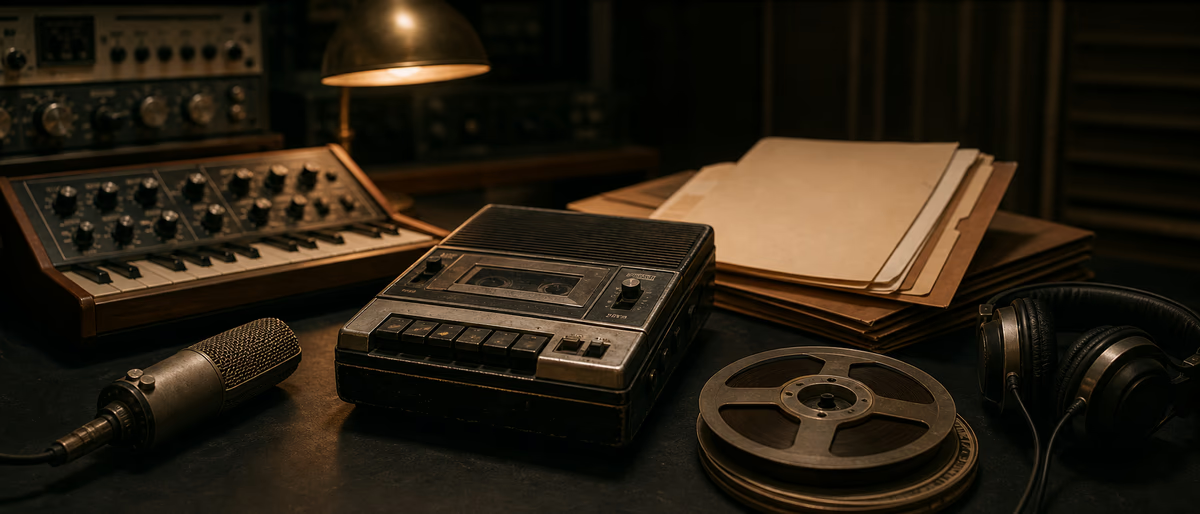
Vintage gear sampling checklist
Rights workflows should be documented before release, not reconstructed during a dispute.
- Save license PDFs or screenshots with timestamps.
- Keep split sheets and contributor approvals in the project folder.
- Record territory, term, allowed uses, and payment terms for each asset.
This is operational education for producers, not legal advice. For a signed deal, dispute, takedown, or high-value sync, ask a qualified music lawyer in the relevant territory.
Lokaler Kontext
Rechts-, Steuer-, Datenschutz-, Rechte-, Royalties- und Vertragsregeln variieren je nach Rechtsordnung. Nutze diesen Artikel als redaktionellen Einstieg, nicht als Rechts- oder Buchhaltungsberatung.
Prüfe vor dem Handeln lokale Gesetze, Zahlungsmethoden, Plattformverfügbarkeit, Steuern und die Verwaltung von Musikrechten in deinem Land.
Kurze Antwort
Vintage gear sampling checklist: Vintage gear does not automatically make a sound copyright-safe. Record whether the source is your own performance, a factory preset, a ROM sample, a demo pattern, or a protected recording, then decide whether release, sync, or sample-pack resale is allowed. This is operational education for producers, not legal advice. For a signed deal, dispute, takedown, or high-value sync, ask a qualified music lawyer in the relevant territory.
What producers should actually document
Vintage gear does not automatically make a sound copyright-safe. Record whether the source is your own performance, a factory preset, a ROM sample, a demo pattern, or a protected recording, then decide whether release, sync, or sample-pack resale is allowed.
Treat clearance as chain-of-title work: who owns the recording, who owns the composition, what use was approved, what territory and term apply, and who gets paid.
A credit line, DM, beat-store receipt, or friendly verbal yes can be useful evidence, but it is not the same as a license that names the rights and permitted exploitation.
Hardware sound
Recording your own synth, drum machine, sampler, or tape noise is usually different from sampling a protected record.
Producer action Document that the performance and recording were yours.
Factory presets and demos
Some vintage gear includes copyrighted patterns, demo songs, ROM samples, or third-party libraries.
Producer action Check manuals and license notes before packaging raw sounds.
Resale and sample packs
Selling isolated multi-samples can trigger different restrictions than using sounds inside a song.
Producer action Avoid redistributing protected factory content as raw assets.
Risk map before release
| Area | Common failure | Conservative move |
|---|---|---|
| Sampling a record through vintage gear | The gear does not erase the original copyright | Clear or replace the source. |
| ROMpler multi-samples | Factory libraries may restrict extraction or resale | Use original performances in tracks, not raw library clones. |
| Demo-song riffs | Preset demos can be protected compositions | Write new parts and avoid recognizable demo material. |
| Marketplace pack claims | Buyers need clear provenance | Include recording notes and excluded-source statements. |
Jurisdiction notes for international releases
Use this as a routing map, not legal advice. A beat uploaded from one country can generate claims in another because platforms, PROs, publishers, labels, and neighboring-right societies each operate on their own rules.
| Territory | Operational caution |
|---|---|
| US | Separate master, composition, mechanical, performance, sync, and DMCA processes. SoundExchange applies to non-interactive digital performance royalties for recordings. |
| EU/EEA | Moral rights and collective-management rules can be stricter than a US-only workflow. Platform takedowns and neighboring rights can involve local societies. |
| UK | PRS, MCPS, and PPL often sit in different parts of the rights stack. Do not assume a US PRO registration covers UK exploitation cleanly. |
| Brazil | ECAD and local publishing administration can affect public performance and neighboring-right collections. Portuguese contract language may matter. |
| Russia | Local collection and enforcement conditions can change quickly. Keep contracts, source files, and payment evidence in case platforms request proof. |
| China | Platform clearance, lyric use, and local distribution rules may require local partner review before release or sync use. |
| Japan/Korea | JASRAC, NexTone, KOMCA, and local neighboring-right workflows can be precise about splits, covers, and sync. Metadata accuracy matters. |
| Turkey/Indonesia | Local collecting societies and platform policies may diverge from US templates. Confirm language, term, and territory in writing. |
| Spanish multi-region | Spain, Mexico, Colombia, Argentina, Chile, and other Spanish-speaking markets are not one legal region. Use country-specific review for campaigns. |
| Arabic multi-region | MENA markets vary by country, platform, and local partner. Treat Arabic-language exploitation as multi-territory unless a contract says otherwise. |
Clearance and enforcement workflow
- 1. Identify the source
Original performance, factory preset, ROM sample, record sample, field recording, or third-party card. - 2. Check the manual and license
Look for restrictions on redistribution, sample libraries, and commercial use. - 3. Record provenance
Photograph gear, save patch notes, date the session, and label any external media. - 4. Package cautiously
For sample packs, sell transformed original recordings, not cloned factory libraries. - 5. Keep buyer terms plain
State commercial music use, raw-file redistribution limits, Content ID limits, and territory if relevant.
Red flags that should stop the upload
| Red flag | Why it matters | What to do |
|---|---|---|
| No source file or license text | You cannot prove what rights came with the asset. | Pause release until the vendor, collaborator, or rights owner confirms terms in writing. |
| Worldwide sync or broadcast promised in a casual message | Sync and broadcast often need explicit rights language. | Ask for a formal license or exclude the use from the pitch. |
| Multiple writers but no split sheet | Publishing money may be misdirected or frozen. | Get dated approvals before distribution. |
| A platform claim arrives before release day | Fingerprinting can reveal hidden samples or duplicate loops. | Resolve the claim before pitching editors, ads, or sync buyers. |
This is operational education for producers, not legal advice. For a signed deal, dispute, takedown, or high-value sync, ask a qualified music lawyer in the relevant territory.
Use Plugg Supply as a source-control step for music assets: keep license notes, source links, stems, and export metadata together before release.
Learning path
Verwandte Answer Hubs
Häufig gestellte Fragen
- Can I sell samples from an old synth?
- Often you can sell original recordings of your own performances, but cloning factory libraries or demo songs can be restricted. Check the manual and source.
- Does running a record through a sampler clear it?
- No. The original recording and composition rights remain.
- Are drum machine hits safe?
- Original drum machine hits are often lower risk than record samples, but factory patterns, ROM content, and trademark-style marketing still need care.
- What should I include in a pack license?
- Commercial music use, no raw redistribution, no false authorship, Content ID limits, and any excluded territories or uses.